You have probably noticed the sudden drop in traditional organic clicks across your marketing dashboards this year. We track these shifts daily, noting that Google AI Overviews now appear on 40 to 60 percent of Malaysian commercial queries. Search engines are fundamentally changing how they present information, turning old habits into seo mistakes ai visibility blockers.
Our data shows that Answer Engine Optimisation requires a completely new approach.
The following sections outline the five patterns that undermine your digital presence. We will show you exactly why these tactics fail and how to fix them.
## Five seo mistakes ai visibility platforms penalizeThese five outdated tactics actively prevent large language models from citing your brand. We encounter these specific aeo content mistakes constantly when auditing Malaysian websites. Modern AI engines require a completely different approach to content structure.
Our SEO veteran founder, Adam Yong, built Adam SEO in 2011 on the premise that rankings are meaningless without tangible business results. Today, that means optimizing for the generative platforms that drive actual conversions.
## Mistake 1: Over-optimised, keyword-stuffed contentStuffing a page with keywords signals to AI models that your content is an unnatural template rather than an authoritative source. We see this practice severely hurting visibility because platforms like ChatGPT prioritize natural language phrasing. ChatGPT processes over 800 million weekly active users globally as of early 2026, and its algorithms filter out repetitive text.
Our recent audits reveal pages where the target keyword appears 15 to 30 times in 800 words. Image alt text and internal anchors often suffer from the same robotic repetition. Both Google and large language models detect this over-optimisation and completely de-prioritise the page.
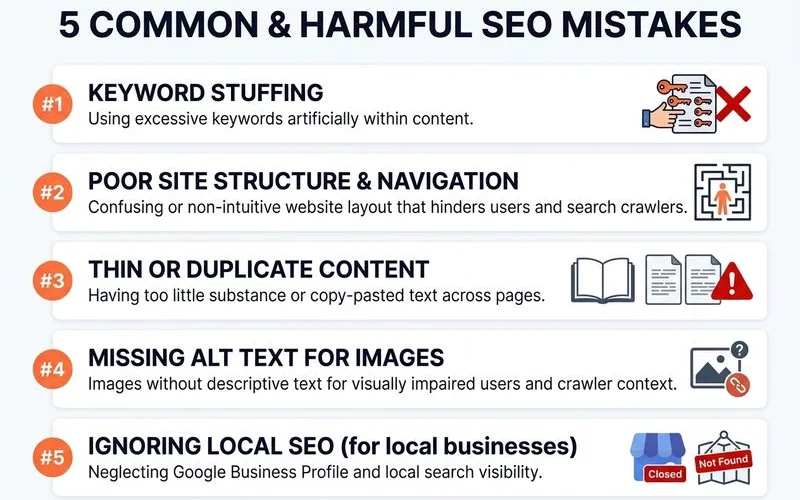 ### The natural phrasing fixWe know this keyword approach was tolerable in 2018, but you must write for the reader today. Target the keyword two to four times naturally across the page. Semantic variants and related terms provide the context these engines need.
## Mistake 2: Empty or thin Organisation schemaShipping only basic Organisation schema leaves AI models without the verified data they need to confidently recommend your business. Our testing confirms that this missing context is a massive seo hurting ai search issue. A March 2026 case study from Schema App demonstrated a 19.72 percent increase in AI Overview visibility simply by implementing proper entity linking.
Many sites ship a bare minimum setup on the homepage with only a name, URL, and logo. We bundle advanced markup into our AEO/GEO services because a basic setup is not enough for accurate AI recognition. The schema needs deep, specific details to perform well.
### Required schema propertiesknowsAbout: The topical areas your brand has expertise in to help LLMs match queries to your brand.hasCredential: Specific certifications, awards, accreditations, and industry recognition.sameAs: Links to LinkedIn, Wikipedia, Wikidata, Crunchbase, and industry directories.address, email, telephone: Accurate local contact information.foundingDate, founder: Clear brand provenance details.This technical work is a one-time effort. Our teams see it materially shift how machines perceive your business.
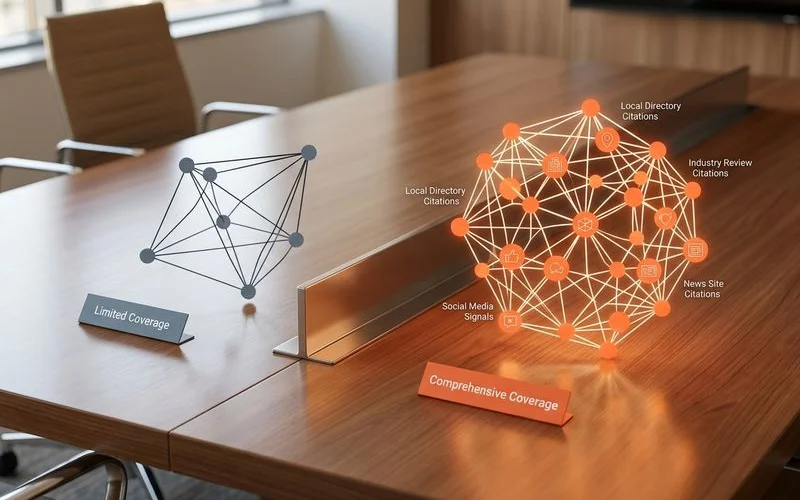
## Mistake 3: Missing entity associationsFailing to establish your brand on authoritative third-party platforms means AI models do not know your entity exists. We identify this exact problem as the biggest single aeo content mistakes gap among Malaysian small and medium enterprises. Content recognized correctly as an entity in knowledge graphs is 50 percent more likely to appear in AI-generated answers.
The brand might exist on its own website, but it remains invisible without external validation. Our strategy requires securing mentions on Wikidata, a completed LinkedIn company page, or coverage in regional publications like Vulcan Post or Tech in Asia. AI models rely on these specific sources to verify your credibility.
### The difference between weak and strong entities| Strategy Element | Weak Entity Presence | Strong AI Validation |
|---|---|---|
| Digital PR | No external brand mentions | Coverage in trusted tech or business publications |
| Social Proof | Empty LinkedIn company page | Active profiles linked via sameAs schema |
| Knowledge Base | Ignored industry directories | Wikipedia or Wikidata entries |
| Thought Leadership | Zero podcast appearances | Guest speaking on regional business shows |
The fix is sustained digital PR and active partnership building. We help clients contribute thought leadership to industry publications and publish original data. These external connections feed the algorithms the verifiable facts they crave.
## Mistake 4: Content that competes with rather than complements training dataPublishing basic definitions that regurgitate existing knowledge adds zero unique value for an Answer Engine. Our research indicates that LLMs already possess Wikipedia-level data and ignore pages offering nothing new. Perplexity AI grew its professional user base in Malaysia by 340 percent recently because users want deep insights over basic summaries.
Citing your page over Wikipedia requires you to add original perspective, unique data, or real-world case studies. We ensure client content provides the exact analytical elements these engines cannot generate themselves. Opinion pieces and proprietary frameworks perform exceptionally well.
The brands that get cited consistently bring genuine, verifiable added value to the conversation, rather than just repeating established facts.
Our data proves that definition pages stuffed with thin content do not make the cut.
 ## Mistake 5: Weak structured data validationSchema markup that fails Google's Rich Results Test silently breaks your ability to appear in AI summaries. We frequently find that sites ship schema once and never check it again. Platform updates, theme changes, or simple plugin conflicts can invalidate your structured data overnight.
Invalid schema can trigger active filtering from search results. Our standard reporting process fixes this by running automated validation across all top-traffic pages.
### Common schema breaking pointsConsistent validation protects your technical foundation against sudden algorithmic shifts.
## A bonus mistake: assuming SEO and AEO are the same jobTreating Answer Engine Optimisation as a simple extension of a traditional SEO playbook guarantees missed opportunities. We see brands losing visibility in tools like Perplexity and Google AI Overviews because their agency ignores entity completeness. With the recent launch of the ChatGPT Go plan in Malaysia for just RM38.99 a month, local consumers are rapidly shifting to conversational search.
AEO absolutely depends on strong SEO foundations. Our methodology recognizes that citation pattern building and advanced schema priorities require genuinely separate tasks. Testing prompts and validating entities fall completely outside the old search playbook.
Brands relying on a vendor without an explicit AEO or GEO scope are likely missing critical visibility. We urge clients to demand specialized AI strategies even when their Google rankings appear strong.
## What to do nextRun the AI visibility self-audit to see how your brand performs across these five surfaces. We designed this process to help you identify systematic seo mistakes ai visibility gaps quickly. Comprehensive remediation is necessary if the audit reveals major issues.
Our AEO/GEO services include entity completeness work, schema overhauls, and citation-pattern building. You will also receive a quarterly scorecard to track your progress.
We provide deeper context on the underlying methodology in our guide on AEO and GEO Explained. You can also explore How to Optimize Content for AI Search to build your internal knowledge.