
AEO and GEO Explained
Plain-language AEO and GEO definitions, how LLMs surface answers, citation patterns, zero-click search, and entity-based SEO foundations.

Our team often speaks with Malaysian business owners who see their website traffic dropping while their Google rankings remain stable. You might have noticed this exact trend in your own monthly reports. This disconnect happens because user search behavior has fundamentally changed in 2026.
Our founder, Adam Yong, built Adam SEO in 2011 on the premise that search rankings are meaningless without tangible business results. Traffic matters, but visibility where buyers actually make decisions is what pays the bills.
So, if you are asking what is aeo geo and why traffic is shrinking, the answer lies in artificial intelligence.
Our strategy focuses entirely on getting your brand cited by these new AI assistants. Let’s review the current data and walk through the exact steps you need to take.
What AEO and GEO actually are
Answer Engine Optimization (AEO) focuses on structuring content so search engines can extract a direct answer that cites your brand. Generative Engine Optimization (GEO) is the specific practice of getting your brand referenced inside Large Language Models like ChatGPT, Perplexity, Gemini, and Claude.
Our agency treats these two practices as a single service line at Adam SEO because their technical requirements overlap heavily. The aeo geo definition simply comes down to making your business readable and trusted by artificial intelligence.
A 2026 report from OpenAI revealed that ChatGPT now has 900 million weekly active users. You need a strategy to reach that massive audience.
We see huge potential here for Malaysian SMEs. A recent study by Brew Interactive found that Perplexity cites external sources an average of 6.6 times per answer. This data proves that AI engines rely heavily on third-party websites to validate their responses.
| Feature | Answer Engine Optimization (AEO) | Generative Engine Optimization (GEO) |
|---|---|---|
| Primary Target | Featured snippets, voice assistants, Google AI Overviews. | LLMs like ChatGPT, Perplexity, and Claude. |
| Core Mechanism | Extracts short, direct facts from structured data. | Synthesizes information from multiple sources to generate a response. |
| Success Metric | Appearing in the “Position Zero” snippet. | Being explicitly cited as a source in the generated text. |
How LLMs actually surface answers
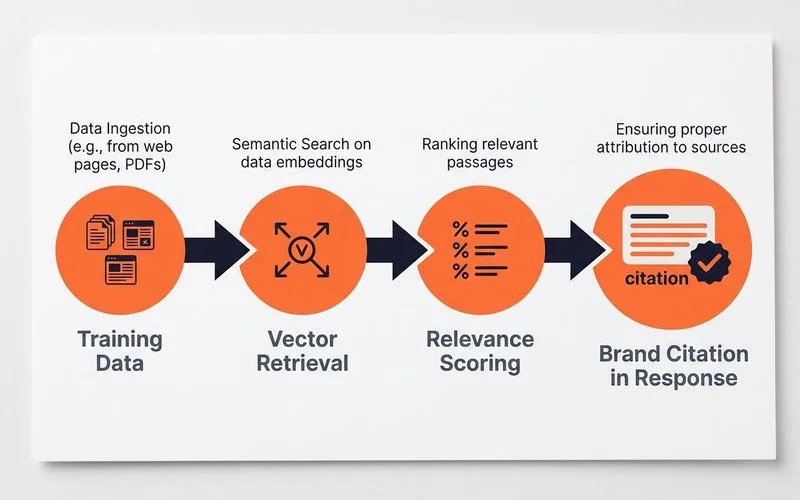
Modern AI assistants combine training data, real-time web searches, and citation signals to formulate their answers. Our testing shows that a brand must perform well across all three mechanisms to appear in a generated response. When an AI receives one of the 2.5 billion daily queries processed globally, it uses a specific framework to decide who gets mentioned.
- Training-data corpus: This is the baseline knowledge baked into the model from its initial training. Wikipedia, large web crawls, and authoritative third-party sources dominate this layer.
- Real-time retrieval: Live search of the web allows the AI to ground answers in current sources. Tools like ChatGPT Search and Perplexity actively crawl the web for up-to-date facts.
- Citation signals: The model looks for structured cues, like schema markup, and unstructured cues, like third-party brand mentions, to decide which sources to trust.
We often explain this process using a simple B2B example. Imagine a buyer asks for the best B2B SaaS agency in Kuala Lumpur. The AI first checks its training memory for known brands, then runs a real-time retrieval for recent reviews, and finally weighs the citation signals before listing its recommendations.
Citation patterns AI models trust
Through manual prompt-testing across thousands of buyer queries, our analysts discovered specific patterns that tell AI models your website is a reliable source. A reliable answer engine optimization strategy feeds the algorithm exactly what it wants to read.
The Trust Signals You Need
Our team prioritizes five specific elements to secure placements in AI overviews. A 2026 technical SEO survey from GoodFirms found that 65% of marketing professionals consider structured data critical for multi-surface visibility. You can implement these formatting rules on your core service pages immediately.
- Clean structured data: You need accurate Organisation, FAQ, and Article schema markup to make your site machine-readable.
- Direct-answer content anatomy: Place a concise 40-60 word direct answer in the first paragraph of your page.
- Question-led page structure: Phrase your H1 and H2 headings as exact questions that your customers ask.
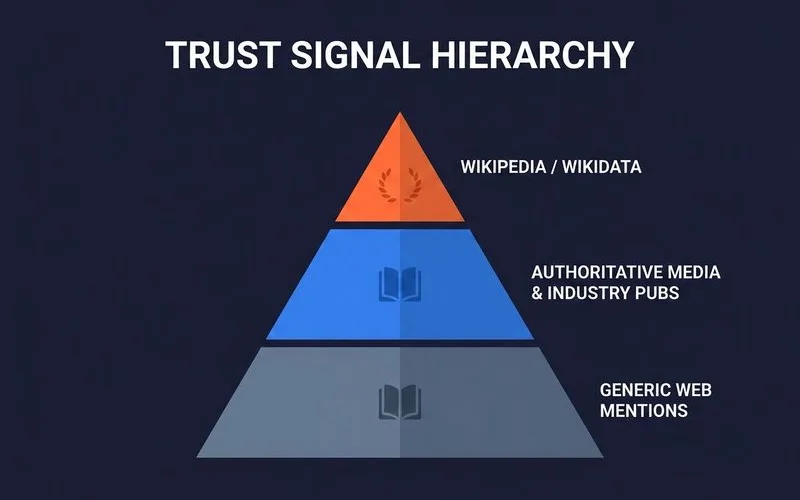
- Third-party validation: The model looks for your brand name in industry publications, news sites, and educational references.
- Knowledge base alignment: Maintaining accurate Wikipedia and Wikidata entries for your category helps establish baseline entity trust.
The Red Flags That Block Visibility
We constantly see local Malaysian brands accidentally blocking themselves from AI citations due to poor content practices. The algorithm will completely ignore your site if it detects these common mistakes.
- Keyword-stuffed thin content: Modern language models easily detect forced keywords and will lower your priority score.
- Redundant information: Regurgitating the exact same facts found on Wikipedia does not add value to the real-time retrieval process.
- Broken technical signals: Empty or invalid schema markup confuses the crawlers.
- Missing Q&A formats: Failing to structure your text as a clear question-and-answer makes data extraction difficult.
Zero-click search and what it means for brands
A zero-click search occurs when a user gets their answer directly from an AI overview without ever clicking a link to visit a website. Our industry analysis confirms that nearly 60% of Google searches in 2026 now end this way. This shift forces a complete rethink of how we measure digital success.
We monitor user behavior closely, and the adoption of generative AI in Southeast Asia is accelerating rapidly. A recent report from Marketing Magazine Asia revealed that 48.4% of Malaysian internet users engaged with ChatGPT in a single month. If your business is cited in those direct AI answers, you acquire valuable brand awareness even without generating a website visit.
Conversely, your brand becomes invisible to a growing share of buyers if the AI never mentions your name.
“If your brand is not cited in AI-generated summaries, you are effectively invisible to a growing segment of buyers who never scroll past the initial answer.”
Traditional SEO measures success entirely through clicks and website traffic. Generative engine optimization measures success through citations and total brand-mention share.
We strongly advise our clients to track both metrics, but AI visibility is increasingly the deciding factor for local business growth. Buyers trust the direct recommendation from Perplexity or Gemini just as much as a traditional word-of-mouth referral.
Entity-based SEO foundations
Entity-completeness is the technical foundation of AEO and GEO, ensuring that search algorithms recognize your brand as a coherent, factual organization. Our technical audits reveal that AI models need clear attributes, like your founded year, service area, and founder details, to validate your existence. Without this complete data profile, your brand is just a random string of characters.
We use a specific process to build this digital credibility across the web. Entity completeness work includes aligning your brand information on Wikipedia and Wikidata where applicable. You must also deploy accurate Organisation schema markup on your homepage.
Structuring Your Digital Profile
A 2025 business report from Ibrandium noted that 65% of Malaysian businesses adopting AI tools report an average revenue increase of 19%. Securing your share of that growth requires giving the AI exact, verifiable details about your company.
This technical work demands consistent brand information across all business directories and social platforms.
- Basic NAP details: Name, address, and local Malaysian phone numbers.
- Schema properties: Using tags like
knowsAbout,hasCredential, andsameAs. - Executive profiles: Linking founder details to Crunchbase or LinkedIn.
- Customer proof: Highlighting notable clients and partnerships.
Why traditional SEO alone is no longer enough
Five years ago, ranking highly on Google search results was entirely sufficient for online growth. Our daily observations confirm that an SEO-strong brand in 2026 will still struggle if entity-completeness and citation patterns are weak. The two practices are converging rapidly, but they require distinctly different daily workflows.
We layer our AEO/GEO services directly on top of a strong traditional search foundation. This dual approach ensures you capture clicks from standard searches while also appearing in ChatGPT and Perplexity answers.
You need to evaluate your current marketing budget and decide where to allocate resources. If you want a clear framework for making that financial decision, read our guide on AEO vs traditional SEO.
Our team recommends establishing a baseline metric before spending any money on new campaigns. You can try out the exact self-audit method we use by reading Is your brand visible in ChatGPT and Perplexity. Take control of your digital footprint today, and ensure the next generation of search engines actually knows who you are.
FAQ
Is AEO the same as featured snippets?
Featured snippets are a subset. AEO covers all direct-answer surfaces including featured snippets, People Also Ask, Google AI Overviews, and LLM-driven generative answers in ChatGPT, Perplexity, and Gemini. The methodology is broader than featured-snippet optimisation alone.
Will traditional SEO still matter?
Yes. Foundational technical SEO (crawl, index, render, schema) and content quality underpin both AEO and GEO. AEO/GEO is layered on top of strong SEO, not a replacement for it. Brands that skipped SEO foundations cannot leapfrog straight to AEO.
Do I need Wikipedia or Wikidata?
Not always, but they help. Wikipedia and Wikidata are training-data inputs for most major LLMs. For brands competing in highly competitive entity spaces (B2B SaaS categories, professional services with established competitors), aligning Wikipedia and Wikidata entities is often a meaningful unlock.
Related guides
What to Expect From an AEO/GEO Engagement
AEO/GEO engagement deliverables, measurement challenges, proxy KPIs, and 6-12 month outlook. What month-by-month progress looks like.
AEO vs Traditional SEO: Do You Need Both?
Where AEO and SEO overlap, where they diverge, and why both matter as zero-click grows. Hybrid roadmap and budget-allocation guidance.
Is Your Brand Visible in ChatGPT and Perplexity?
DIY audit framework to check if AI search engines surface your brand, manual prompt tests, brand-mention checks, common reasons for invisibility.
The Future of Search: Planning for AI-First Discovery
Strategic implications of the AI-search shift, zero-click trajectory, AI Overviews rollouts, decision framework for budget allocation, risk of inaction.
Ready to talk about AEO and GEO Services?
Our aeo and geo services retainers are senior-led and tied to revenue. Free discovery audit, no obligation.