
SEO vs Google Ads: Which Delivers Better Long-Term ROI?
Honest CAC comparison between SEO and Google Ads for Malaysian SMEs, when each wins, when to run both, and the asset-vs-expense framing.

SEO vs Google Ads: The wrong question, the right framing
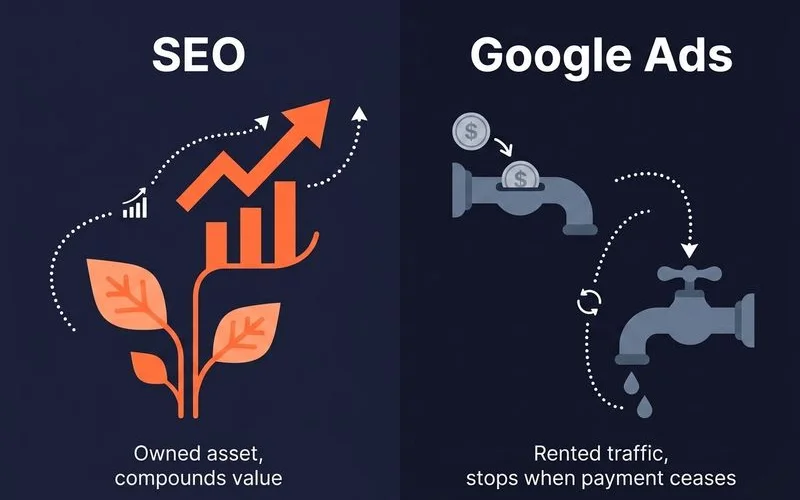
You know how every marketing discussion eventually loops back to the classic seo vs google ads dilemma. Local business owners often treat this as a binary choice. Our honest framing approaches this conversation differently: it is a fundamental choice between building an asset and managing an expense.
Google Ads functions as a rented digital channel. You pay a specific price per click, and your traffic drops to zero the moment you pause that budget. Internal data reveals that no compounding asset remains when you walk away from a paid platform.
SEO, conversely, serves as an owned digital channel. It takes months to establish authority, but those rankings keep generating targeted visits long after the initial work is complete. We find that the most successful companies eventually stop asking whether to choose seo or google ads.
The right question focuses on finding the exact mix and sequence for your specific situation.
When evaluating ppc vs seo malaysia, you must look at the hard numbers. Let’s examine the actual data behind customer acquisition costs, what these numbers tell us about buyer behaviour, and how to build a profitable hybrid strategy.
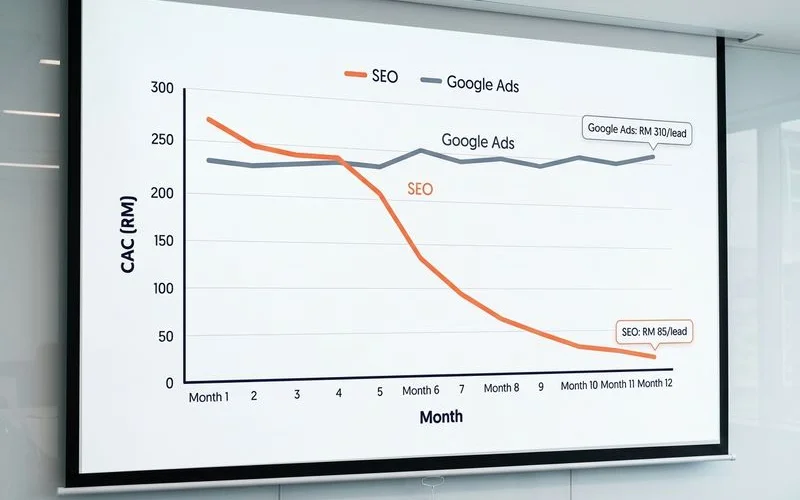
CAC trajectory over twelve months
Google Ads provides a highly predictable Cost Per Acquisition (CAC) right out of the gate. You can launch a campaign on Monday and see leads flowing in by Tuesday afternoon. This immediate visibility comes with a rigid price floor.
In highly competitive Malaysian sectors like legal services or finance, Cost Per Click (CPC) averages often range from RM 5.00 to RM 25.00 per click. You might see a slight drop in your acquisition costs through careful campaign optimisation. That said, you will rarely see your Google Ads CAC drop by half once the market sets the baseline keyword price.
Search engine optimisation presents a completely reversed financial curve. Your CAC is effectively infinite during the first three months of an organic campaign. A standard Malaysian SEO retainer typically ranges from RM 1,500 to RM 5,000 per month, and you pay this fee while building technical infrastructure.
| Campaign Month | Google Ads CAC Impact | Organic Search CAC Impact |
|---|---|---|
| Months 1-3 | Stable, immediate baseline cost | Effectively infinite (investment phase) |
| Months 4-6 | Slight reductions via optimisation | Cost per lead drops below paid channels |
| Months 8-12 | Costs plateau or rise with competition | Compounding traffic severely undercuts paid |
Things begin to shift dramatically between months four and six. Your organic content starts generating real revenue, and the acquisition cost for specific keyword sets finally drops below the paid search equivalent. We typically see the 283 percent revenue trajectory kick in around month eight, at which point the organic cost undercuts paid advertising significantly.
A healthy business model requires a Customer Lifetime Value to CAC ratio of at least three to one. Most profitable companies achieve this by running both channels simultaneously over a two-year period. Our data confirms this combined approach often results in a blended acquisition cost sitting 30 to 50 percent lower than running a standalone paid campaign.
When Google Ads wins
Certain business scenarios demand immediate visibility and precise control over consumer traffic. We frequently advise clients to allocate budget to paid search when time sensitivity outweighs the need for long-term compounding assets. A typical Malaysian SME might set aside a starter budget of RM 1,500 to RM 3,000 per month specifically to capture high-intent buyers.
Market data indicates that Google Ads becomes the superior choice in these specific situations:
- You just launched operations: New websites need immediate lead generation to maintain cash flow while the slower organic strategy takes root.
- Massive seasonal pushes: E-commerce conversion rates spike during major retail events like Hari Raya Aidilfitri, Hari Merdeka, and the 11.11 sales festival.
- Aggressive brand defence: Competitors will often bid on your specific company name.
- Rapid inventory clearance: Limited-time promotions require instant distribution to a targeted audience before stock becomes obsolete.
- Testing new market demand: You can run small paid campaigns to verify search volume and conversion rates before committing heavy resources to permanent organic content.
A common pitfall occurs when businesses rely entirely on this channel for years. You must treat this platform as a strategic tool for rapid deployment, not as your only source of customer acquisition.
When SEO wins
Organic search focuses entirely on building digital equity that you permanently own. We view this channel as the primary growth engine for companies operating in complex or high-value markets. A 2025 Hashmeta report noted that while social media captures attention, heavy purchasing decisions still rely on deep, intent-driven web searches.
Strategic teams recommend prioritising an organic strategy when your business model aligns with these criteria:
- Your buyers conduct research-heavy purchases: Customers looking for B2B software, corporate legal representation, or high-end consumer electronics often take weeks to evaluate options.
- You possess strong profit margins: The business needs sufficient runway to invest continuously for six to twelve months before the compounding visibility fully matures.
- Your competitive landscape is highly searchable: Your target audience actively looks for solutions via search engines rather than relying purely on TikTok trends or word-of-mouth referrals.
- You want to defend against AI search shifts: Generative Engine Optimisation (GEO) relies on a solid organic foundation to feed systems like ChatGPT and Perplexity.
The hidden cost of ignoring organic traffic
Many business owners mistakenly delay their organic investments because they fear the upfront technical costs. This hesitation creates a massive vulnerability. We often audit local companies spending MYR 10,000 a month on ads just to maintain their baseline revenue.
Competitors who invested in organic assets three years ago now acquire the exact same customers for a fraction of the cost. You cannot buy your way out of a poor digital foundation forever. The math eventually forces every growing company to build an owned audience.
The hybrid recommendation
The most successful marketing campaigns refuse to treat these channels as isolated silos. We recommend running both paid and organic strategies simultaneously for the vast majority of our retained clients.
A typical year-one budget split often lands at 60 percent paid advertising and 40 percent organic optimisation.
As the compounding effect takes hold in years two and three, that financial split usually inverts. You will likely transition to 40 percent paid and 60 percent organic.
The exact ratio always depends on your competitive set, product margins, and sales-cycle length. We map these specific variables out in detail during a free discovery audit.
If monthly pricing remains your primary concern, you should review our comprehensive SEO cost in Malaysia breakdown. If you operate a brick-and-mortar SME, the Local SEO vs Google Ads comparison offers a more relevant perspective.
Executing a unified digital strategy
The brutal truth is that companies winning the market in 2026 run organic and paid search in parallel. They utilise a unified strategy where paid keyword data actively informs organic content creation.
A recent 2026 industry forecast projects digital advertising will command up to 80 percent of total marketing budgets globally. This massive shift makes marketing efficiency absolutely paramount.
Adam Yong founded Adam SEO in 2011 on the core premise that search engine rankings alone mean nothing without tangible business outcomes.
We service the organic side of your business and partner directly with your paid media team. This collaborative approach provides the joint reporting necessary to make a hybrid strategy generate genuine revenue.
Schedule your discovery session today to analyse your current search footprint and finally resolve your internal seo vs google ads debate with a profitable, data-driven roadmap.
FAQ
Should I pause Google Ads when starting SEO?
No. Pausing Ads kills near-term revenue while SEO is still compounding. The mature pattern is running both: Ads cover the gap and brand defence in the first 6-12 months while SEO builds owned visibility. Once organic compounds, you can shift budget proportionally.
What is a good SEO and Ads budget split?
Often 60/40 paid versus organic in year one, shifting to 40/60 by year three as SEO compounds. The exact mix depends on your sales cycle (long cycles favour SEO earlier), product margin, and competitive set. We help clients model this during the discovery audit.
Do you manage Google Ads too?
We focus on organic search, AEO/GEO, and CRO. We work alongside your paid-media partner with shared reporting and joint planning. The hybrid stack is most effective when both channels share goals and attribution.
Related guides
How Long Until SEO Delivers Results in Malaysia?
Realistic month-by-month SEO timeline for Malaysian SMEs. Foundational signals at 1-2 months, ranking lifts at 3-6, compounding revenue at 8-12 and beyond.
How to Choose an SEO Agency in Malaysia (2026 Buyer's Checklist)
A buyer's checklist for vetting Malaysian SEO agencies, red flags to spot, the right questions to ask, and what mid-market premium pricing should buy.
How Much Does SEO Cost in Malaysia? (2026 Pricing Guide)
Honest breakdown of SEO pricing in Malaysia, RM 2,500 to RM 9,500 per month tiers, what drives cost, and why mid-market beats RM 500 per month mass providers.
The 4-Stage, 9-Step SEO Framework Explained
Adam SEO's proprietary 4-Stage 9-Step framework: Analysis, CRO, SEO Optimization, Re-Engagement. The methodology behind documented 283% revenue case studies.
Ready to talk about your SEO programme?
Free discovery audit, senior-led, no obligation. Limited slots each month.