
Technical SEO vs On-Page SEO
Technical foundation before on-page wins amplify. When on-page is enough, when technical issues block all progress, and an audit-first methodology.

You know how frustrating it is to publish great content and see zero traffic. Our team at Adam SEO, an agency founded by Adam Yong back in 2011, sees this exact scenario constantly.
That technical debt acts like an invisible ceiling on your online growth. We often find that choosing between technical seo vs on page seo is the biggest hurdle for new clients. The reality is that technical or on page seo first depends entirely on your website’s baseline health.
Our specialists will show you exactly how to diagnose your site and execute proper seo sequencing for maximum return. This guide breaks down the symptoms, costs, and exact decision logic you need to move forward.
When technical foundations matter
Technical SEO must come first when search engines physically cannot access, read, or trust your website. Fixing these structural blockers ensures your content actually has a chance to rank.
We always check a site’s technical foundation before writing a single word of new content. If Google cannot crawl, render, or trust your site, no amount of on-page optimisation will rank you. Our audits frequently uncover massive technical roadblocks capping on-page returns.
Symptoms that say technical SEO is the priority:
- GSC Coverage report shows large numbers of “Excluded” or “Crawled not indexed” pages
- Core Web Vitals are failing (Poor LCP, CLS, or INP) on top revenue templates
- You ship JS-heavy pages and Google’s mobile-friendly tester shows broken rendering
- Schema validation is failing on top templates
- Site has been replatformed in the last 12 months and traffic dropped without explanation
- robots.txt or canonicals are misconfigured (you can spot-check with simple GSC URL Inspection)
We tracked the latest 2026 data from Hashmeta, revealing that 43% of sites still fail the new Interaction to Next Paint (INP) threshold. This specific responsiveness metric replaced FID in 2024 and directly impacts the user experience.
Our developers also note that a simple one-second delay in your page load time can reduce conversions by 7%. If you are seeing any of these symptoms, technical work pays back much faster than on-page work.

When on-page work is enough
On-page SEO becomes the primary focus only after your site’s technical health is verified and stable. You shift resources here to build topical authority and outrank competitors through superior content.
We recommend an on-page focus for clients who already have clean technical fundamentals. This means zero indexation issues in Google Search Console and passing Core Web Vitals scores. Our typical resource allocation in these healthy scenarios is 80 percent of effort into on-page work and 20 percent into technical maintenance.
On-page work is the right primary investment when:
- Technical fundamentals are clean (no GSC indexation issues, CWV is mostly Good)
- Your competitors out-rank you because they have richer content, better headlines, more in-depth pages
- You are entering a new keyword space and need to build topical depth
- Your category is mature and ranking comes down to content quality and link velocity rather than platform optimisation
We regularly see Malaysian SMEs missing out on basic on-page opportunities. A recent 2026 AEO Agency audit highlighted that fewer than 30% of local websites use structured data correctly.
Our strategy now heavily features Answer Engine Optimisation (AEO) to capture traffic from Google’s AI Overviews. This modern approach requires putting a clear, direct answer within the first 100 words of your page content.
When technical issues block all progress
Severe technical errors make any content investment completely useless until they are resolved. Fixing these critical bugs is the highest-leverage activity in search engine optimisation.
We consider certain errors to be absolute emergencies that halt all other marketing efforts. Some technical issues are so severe they make on-page work pointless until fixed. Our technical team prioritises these massive blockers to clear your site’s path.
Critical issues include:
- Site-wide noindex tags accidentally applied (we have seen this on three audits in the last year, every time the cause was a developer forgetting to remove staging-environment noindex on a deploy)
- Massive faceted-nav indexation (millions of duplicate URLs diluting category page authority)
- Robots.txt blocking critical paths (we saw a Malaysian e-commerce site blocking
/products/last year, all on-page work was wasted until fixed) - Broken JS rendering so Googlebot sees an empty page
- Severe Core Web Vitals failures (LCP over 6s on top traffic templates)
We recently handled a case where severe LCP failures caused massive customer drop-offs. Industry benchmarks from 2026 confirm that 53% of mobile users abandon sites that take longer than three seconds to load.
Our engineers focus entirely on fixing these issues before any on-page work begins. They are the highest-leverage fixes in seo sequencing because they enable everything else.
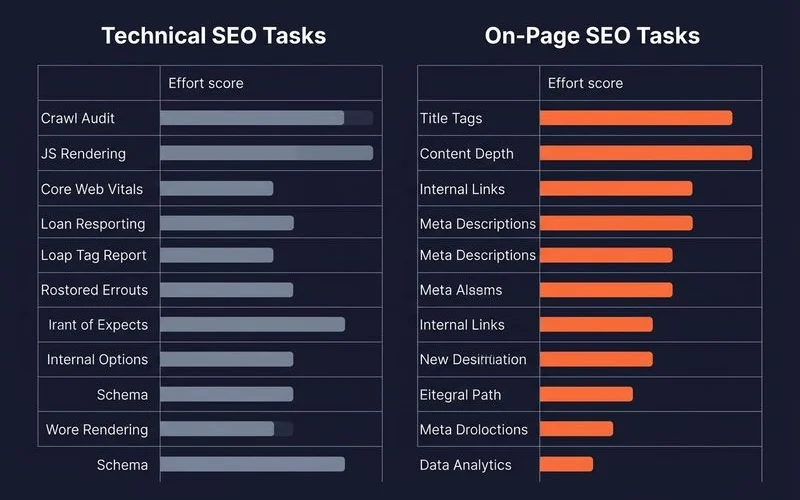
Cost-effort comparison
On-page work carries a predictable cost based on content volume, while technical fixes vary wildly depending on the platform’s codebase. A simple content update takes hours, but a deep technical overhaul can take months.
We structure our pricing based on the predictability of these two distinct phases.
| Category | Cost Predictability | Typical Effort Required | Key Characteristics |
|---|---|---|---|
| On-Page Work | Highly predictable | 1 to 3 hours per page | Content-heavy, template-friendly, easily parallelised |
| Technical Work | Highly variable | Hours to multi-month projects | Requires deep audit, platform-dependent, fixes compounding issues |
Cheap initial website builds often create expensive technical debt later. While a basic Malaysian web design package might cost RM2,200, fixing the resulting structural errors requires significant specialist hours.
Our agency knows that a schema gap fix takes hours, whereas a Core Web Vitals overhaul on a JS-heavy application takes weeks. A faceted-nav cleanup on a large WooCommerce store is often a multi-month project requiring a custom quote.
We run both strategies concurrently on most retainers after the initial 4 to 8 week technical sprint. The first quarter is technical-heavy, then quarters 2 through 4 are on-page-heavy with minor technical maintenance.
Audit-first methodology
Every successful campaign must start with a comprehensive technical audit to identify traffic-blocking errors. You then patch these critical issues before scaling up your content production.
We apply a strict audit-first methodology to every single retainer. The right sequencing for nearly every engagement follows a proven, structured path.
The right sequencing for nearly every retainer:
- Run a Technical SEO audit as week one of the engagement
- Identify the top 5-10 highest-impact technical issues that block compounding
- Ship those fixes in weeks 2-6 with proper staging and rollback
- Start on-page work in parallel from week 4 onward
- Run the longer technical tail (smaller fixes) over months 3-9
- Continuous on-page work runs throughout the retainer
We see massive early gains by adhering to this specific timeline. Resolving core web vitals and mobile responsiveness early boosts organic traffic by 20 to 40 percent within the first three months.
Our approach front-loads the fixes that trigger compounding growth and starts on-page work as soon as it can pay back.
Your Next Steps for SEO Diagnostics
Taking action requires understanding your current baseline performance. We recommend reviewing specific documentation to evaluate your site properly.
For audit scope, see What does a Technical SEO audit cover. Our team also strongly suggests monitoring specific metrics, so review these Core Web Vitals issues hurting your rankings. For ongoing support, our Technical SEO services integrate this exact audit-first methodology into every retainer.
FAQ
Can I do on-page SEO without fixing technical?
If technical foundations are solid (Google can crawl, render, index your site), yes, on-page work compounds normally. If you have crawl or index blockers (robots.txt issues, JS rendering failures, broken canonicals), on-page wins do not compound because Google cannot see them. Audit first.
Is on-page SEO cheaper?
Usually yes per task. On-page work (titles, headers, internal linking, content edits) is template-friendly and scales. Technical fixes vary widely by platform and severity, a Core Web Vitals overhaul can be a multi-week dev project. Cost comparison depends entirely on what your audit surfaces.
Do I need to fix everything technical before starting on-page?
No. Fix the top 5-10 highest-impact technical issues that are blocking compounding (indexation issues, broken canonicals, severe CWV). Then run on-page in parallel with the longer technical tail. Most retainers run both workstreams concurrently after the initial sprint.
Related guides
Core Web Vitals Issues Hurting Your Rankings
LCP, CLS, INP definitions, common causes per metric, theme/plugin culprits in WordPress, image optimisation, JS blocking, lab vs real-user data.
What Does a Technical SEO Audit Cover?
What is included in a professional technical SEO audit, crawl, render, Core Web Vitals, schema, mobile-first checks, and a deliverable structure.
Ready to talk about Technical SEO Services?
Our technical seo services retainers are senior-led and tied to revenue. Free discovery audit, no obligation.