
AEO vs Traditional SEO
Where AEO and SEO overlap, where they diverge, and why both matter as zero-click grows. Hybrid roadmap and budget-allocation guidance.
You know how frustrating it is when traffic numbers drop despite holding top keyword positions. Many business owners are currently asking the same question: do I need both SEO and AEO? We see this confusion daily as search habits shift rapidly across the region.
A complete strategy requires blending traditional tactics with the newer Answer Engine Optimization format.
When Adam Yong founded our agency, Adam SEO, back in 2011, the core premise was simple: search engine rankings alone are meaningless without tangible business impact. This philosophy remains true today as artificial intelligence reshapes the internet.
We will outline exactly where these two disciplines overlap, highlight where they diverge, and share a practical roadmap for allocating your marketing budget.
Where AEO and SEO overlap
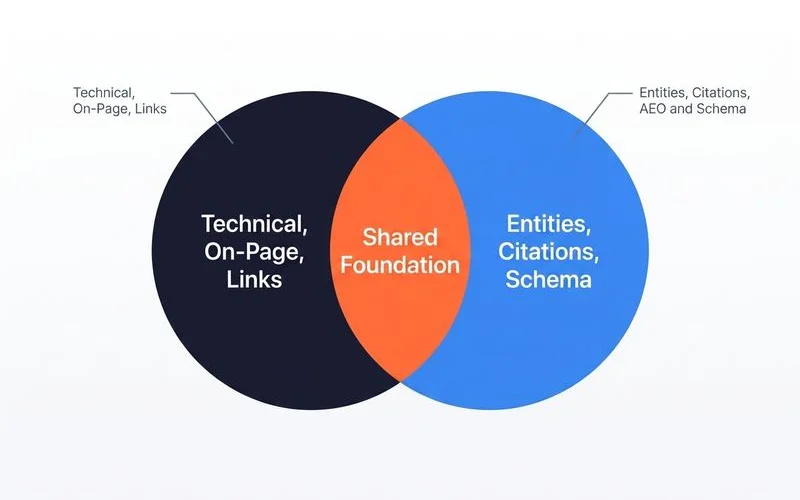
The technical baseline and content authority form the exact point where aeo vs seo overlap. You cannot succeed in AI search without a fast, well-structured website. Our experience shows that roughly 70 to 80 percent of the foundational work is shared between the two practices.
This shared groundwork makes technical maintenance highly efficient. We always layer AEO retainers on top of strong SEO foundations and never replace them entirely.
The two practices share substantial foundational work:
- Technical foundation: crawlability, indexation, Core Web Vitals, schema, mobile-first
- Content quality: useful, well-structured, accurate, authoritative
- Site architecture: internal linking, hub-and-spoke topical structure, breadcrumbs
- Brand signals: NAP consistency, third-party mentions, recognised entity
Tools like Screaming Frog remain essential for verifying this shared technical baseline. A 2026 Semrush study found that 58.5% of US searches conclude entirely within Google’s results page, highlighting the need for flawless technical delivery. Our technical teams prioritize Core Web Vitals and Schema markup to ensure search engines can instantly parse and serve your content.
Where they diverge
When comparing aeo or seo, the core difference lies in how you measure success and structure content. While the technical base is similar, the remaining 20 to 30 percent represents genuinely different work. Our strategies must adapt to target direct answers instead of just traditional clicks.
| Dimension | Traditional SEO | AEO/GEO |
|---|---|---|
| Primary metric | Rankings, organic traffic | Brand citations, AI mention share |
| Content focus | Keywords, topic match | Direct answers, question-led structure |
| Schema priority | Product, Organisation, Article | FAQ, HowTo, Organisation with knowsAbout/sameAs |
| Entity work | Light (NAP, brand consistency) | Heavy (Wikidata, Wikipedia, knowledge graph) |
| Measurement | Google Search Console, GA4 | Manual prompt testing, brand-mention tracking, llms.txt |
| Cycle time | 3-12 months for ranking lifts | 6-12 months for citation-share lifts |
The work overlaps heavily, but the focus and measurement differ significantly. A major shift is the reliance on manual prompt testing across different AI platforms. Our analysts now track citations on platforms like Perplexity, which secured over 5% of the AI chatbot market share in Malaysia by early 2026. This metric was completely irrelevant a few years ago.
Why both are required as zero-click search grows
You need both disciplines because zero-click search is now a meaningful share of buyer queries. Users frequently get an answer without clicking through to any website. Our data indicates that if your brand is invisible in those instant answers, you lose market share to cited competitors.
The acceleration of this trend is undeniable. Similarweb’s 2026 data shows the global zero-click rate reaching nearly 64.8%, and queries triggering AI Overviews hit an astonishing 83% zero-click rate. We know this fundamental shift means users are getting what they need instantly. Traditional optimization measures clicks, while answer optimization measures citations and mention share.
Both metrics matter, but the relative weight is shifting quickly toward citations. Mobile users now experience a 77% zero-click rate, meaning they rarely leave the search page. Our clients who defend traditional clicks while ignoring AI citations are losing year-on-year share to tech-savvy competitors. ChatGPT processes over one billion queries per week, and ignoring that volume is a critical mistake.
The hybrid roadmap
Our hybrid roadmap combines technical site audits with aggressive entity building to capture both traditional and AI-driven traffic. This phased approach ensures your website remains competitive across all platforms. We structure this process over a full year to build compounding authority.
For most Malaysian SMEs, the hybrid roadmap looks like this:
Months 1-3 (foundation):
- Technical SEO baseline (crawl, indexation, schema validation)
- Content audit and topical-map planning
- Entity audit (Wikipedia/Wikidata gap, third-party mentions, schema gaps)
Months 4-9 (build):
- Content velocity for topical depth (4-6 assets per month)
- Schema overhaul (FAQ, HowTo, Organisation enrichment)
- Digital PR and authoritative-citation building
- Prompt-testing baseline and tracking
Months 10-12+ (compounding):
- Rankings on commercial keywords climb
- Brand citations in ChatGPT/Perplexity/Gemini start showing up
- llms.txt traffic appears (early indicator of AI-search referral)
- Quarterly AEO scorecard documents citation-share growth
We typically see organic traffic stabilize during the foundation phase before citation metrics begin climbing. A 2026 KLIQ Interactive report revealed that AI referral traffic converts at 14.2%, compared to just 3.2% for traditional organic traffic. Our compounding phase aims directly at capturing this high-intent audience.
Budget allocation heuristics
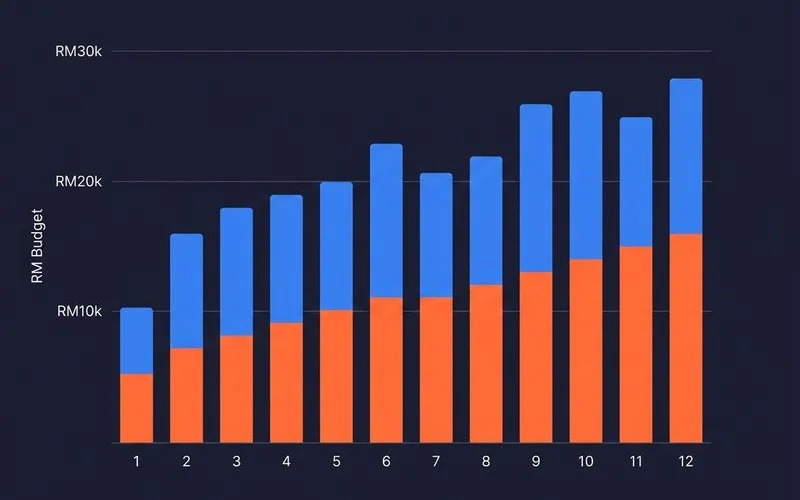
Budgeting correctly requires gradually shifting resources from foundational technical fixes toward active citation building. We recommend a three-year transition plan to manage costs effectively. Malaysian SMEs typically spend between RM 2,000 and RM 10,000 monthly on digital marketing services.
For a typical Malaysian SME running a Premium-tier SEO retainer (RM 4,500/month), the split looks like this:
- Year 1: 80-85 percent traditional SEO + 15-20 percent AEO/GEO. Foundational work dominates; entity and schema fixes ship.
- Year 2: 70-75 percent traditional SEO + 25-30 percent AEO/GEO. Content velocity continues for SEO; AEO citation-building campaigns ramp.
- Year 3+: 60-65 percent SEO + 35-40 percent AEO/GEO. The two converge as AI search captures more buyer attention.
The exact financial split depends on the competitive intensity of your category. A high-growth B2B SaaS company in an established market may shift faster. Our local service-area business clients often stay dominant in traditional maps a bit longer, though 73% of local service queries in Malaysia now trigger an AI response. You must adjust these heuristics based on your specific vertical. We notice that e-commerce brands require heavier initial investments in product schema markup.
When to add AEO/GEO scope
You should add this scope the moment you notice competitors showing up in AI-generated summaries for your core products. This visibility signals that users are researching your category through chat interfaces. Our team advises making the investment if any of the following statements are true for your business:
- Your category has research-heavy or comparison-heavy buyer behaviour
- Your competitors are getting cited in ChatGPT/Perplexity for queries you used to own on Google
- Your brand is barely visible across Google AI Overviews for branded and category queries
- You are running E-commerce SEO and want to defend Google Shopping share against AI shopping assistants
Missing the transition window means losing access to users who no longer scroll through links. ChatGPT currently commands over 80% of the AI chatbot market share in Malaysia. We know that choosing between aeo vs seo is a false dilemma; optimizing for these specific platforms together is critical for future growth.
For dedicated AEO/GEO work, our services bundle CRO and run on Premium tier upward. For broader strategic context on where the industry is heading, see The Future of Search.
FAQ
Should I cut SEO budget for AEO?
No. AEO depends on SEO foundations: technical SEO, indexable content, valid schema, content quality. Cutting SEO to fund AEO is like building the second floor of a house while removing the foundation. Better to add AEO budget on top of existing SEO.
Will AEO replace SEO?
No. They will increasingly converge but core SEO discipline still underpins both. Even five years from now, Google and AI models will still need to crawl, index, and trust your content via the same foundational signals SEO is built on.
What percentage of SEO budget should I move to AEO?
For most Malaysian SMEs, 0-15 percent of total SEO budget on dedicated AEO work in year one (entity completeness, schema overhaul, prompt-testing). Year two often shifts to 20-30 percent as AI search captures more buyer attention. Beyond that depends on category competitive intensity.
Related guides
What to Expect From an AEO/GEO Engagement
AEO/GEO engagement deliverables, measurement challenges, proxy KPIs, and 6-12 month outlook. What month-by-month progress looks like.
Is Your Brand Visible in ChatGPT and Perplexity?
DIY audit framework to check if AI search engines surface your brand, manual prompt tests, brand-mention checks, common reasons for invisibility.
The Future of Search: Planning for AI-First Discovery
Strategic implications of the AI-search shift, zero-click trajectory, AI Overviews rollouts, decision framework for budget allocation, risk of inaction.
How to Optimize Content for AI Search Engines
Actionable AEO content techniques, question-led structure, entity completeness, schema priorities, citation patterns, semantic clustering, FAQ schema.
Ready to talk about AEO and GEO Services?
Our aeo and geo services retainers are senior-led and tied to revenue. Free discovery audit, no obligation.