
E-commerce SEO vs Google Shopping
Honest comparison: E-commerce SEO vs Google Shopping Ads. CAC over time, when each dominates, ROAS expectations, and the hybrid stack approach.

The wrong question, the right framing
From what I have seen, the ecommerce seo vs google shopping debate misses the real issue for most Malaysian online stores. The honest framing is the asset-versus-expense trade-off.
We founded Adam SEO in 2011, and Adam Yong built this agency on the premise that search engine rankings alone are meaningless without tangible business results. A smart strategy requires understanding how platforms like Shopee and TikTok Shop now control about 60 percent of the local market share in 2026.
Our team will break down the exact cost trajectories and show you the hybrid approach that works today.
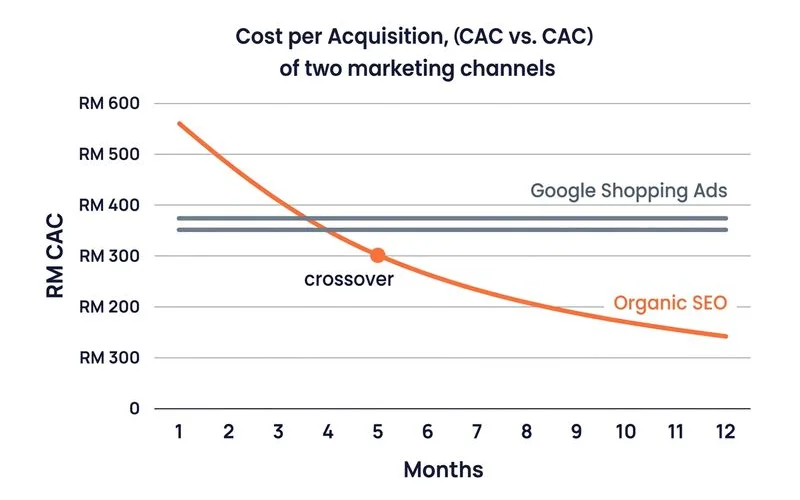
CAC trajectory comparison
Google Shopping and Performance Max deliver immediate product visibility for direct-intent queries.
Our data shows the average Cost Per Click (CPC) for retail campaigns in Malaysia sits between RM1 and RM3 in 2026. This translates to an average click-through rate of 0.86 percent and a conversion rate of 1.91 percent based on recent industry benchmarks.
We see optimisations bringing marginal improvements of 5 to 15 percent over six months. When your budget pauses, traffic and revenue stop within hours.
| Metric | Google Shopping (2026 Avg) | E-commerce SEO (Month 12+) |
|---|---|---|
| Average CTR | 0.86% | 2.1% to 2.8% |
| CAC Trajectory | Flat / Stable | Decreasing / Compounding |
| Budget Pause | Traffic stops instantly | Traffic remains stable |
| Ideal Use Case | Direct intent, new launches | Branded terms, long-tail |
The organic vs google shopping cost curve looks completely different.
Our clients experience an effectively infinite Customer Acquisition Cost (CAC) for the first three to four months while paying the retainer and building organic revenue. By month six, organic traffic begins covering the retainer cost.
We typically see the blended CAC for stores running both channels land 30 to 50 percent below paid-only options by month 12. After 18 to 24 months, the SEO-driven owned channel runs at zero marginal CAC for the queries it owns.
Our strategy relies on this compounding asset effect because Shopping simply cannot replicate it. Organic search effectively captures branded terms, long-tail searches, and evergreen category discovery.
When Google Shopping dominates
Direct intent matching is where paid channels shine brightest.
We always recommend Standard Shopping campaigns over PMax if your monthly budget is under RM 5,000. The Performance Max AI requires a minimum of 30 to 50 conversions per month to exit its learning phase.
Our experience shows that small budgets get wasted on algorithmic guessing without this conversion volume. Many owners ask whether they need ecommerce seo or pmax, and the answer is that paid shopping naturally dominates in several specific scenarios.
- Price-sensitive commodity SKUs where direct intent matching wins on CTR.
- New product launches where you have zero ranking authority for the SKU.
- Seasonal pushes like Raya, year-end sales, or school holidays.
- Inventory clearance when speed matters more than CAC efficiency.
- Categories where SEO compounds slowly due to low search volume.
Forums and e-commerce communities in 2026 constantly share a valuable insider tip regarding zombie products.
Our advice is to keep low-volume or highly specific items out of automated campaigns. These products perform much better when you retain manual bidding control in a Standard Shopping setup.
When E-commerce SEO dominates
Organic search secures the foundational traffic that protects your profit margins.
We focus our efforts on areas where paying per click destroys profitability. E-commerce organic conversion rates frequently hit 2.1 to 2.8 percent globally according to recent 2026 benchmarks.
Our internal data confirms that Malaysian shoppers actively scroll past the sponsored tags. They perceive organic listings as more trustworthy and human-vetted.
We see organic search dominating in these distinct areas.
- Branded queries like “buy [your brand] [product]” where you should never pay to win your own brand name.
- Long-tail product queries such as “waterproof red shoes size 8 women Malaysia” where bidding is inefficient.
- Category-discovery searches like “best industrial pumps for chemical plants” that drive top-funnel awareness.
- Image search for visually-driven categories like fashion, home decor, and jewellery.
- Comparison content such as “Brand A vs Brand B” that buyers research before purchasing.
The hybrid recommendation
Smart stores run both channels in parallel.
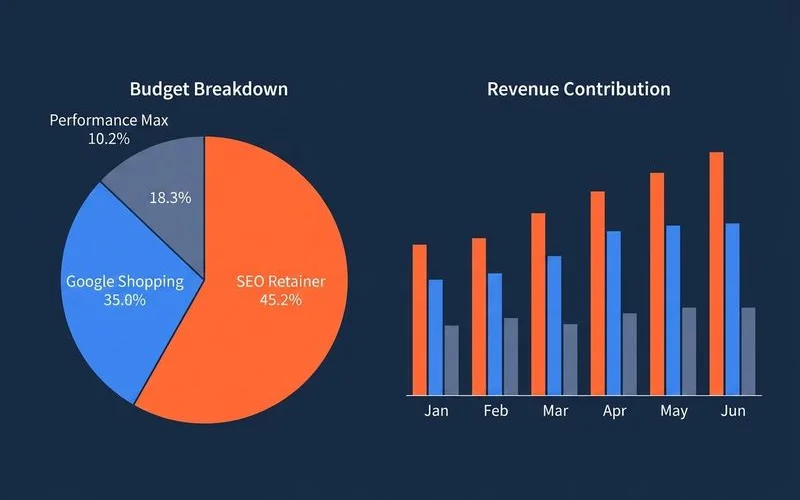
We map out a specific timeline for most stores in our retainer to balance immediate sales with long-term growth. The exact ratio depends on your margin, sales-cycle length, and competitive intensity.
Our standard hybrid stack evolves significantly over a three-year period. The progression typically follows this structure.
- Year 1: 65 to 70 percent paid (Shopping, PMax, Search), alongside 30 to 35 percent SEO retainer and foundational technical SEO.
- Year 2: Shifts to 50 to 55 percent paid, and 45 to 50 percent SEO as compounding takes hold.
- Year 3+: 35 to 40 percent paid for high-intent generic queries and seasonal pushes, with 60 to 65 percent SEO handling branded, long-tail, and category-discovery.
Premium-margin branded products can shift to an SEO-dominant mix much earlier.
Our clients with commodity competition and thin margins stay paid-dominant longer because volume dictates survival. Strategy requires adapting to these commercial realities.
ROAS expectations
Return on Ad Spend (ROAS) is the core metric for measuring channel viability.
We track these numbers closely for our Premium tier E-commerce SEO retainers (RM 4,500/month) on stores above RM 50,000 monthly revenue. Paid Shopping ROAS varies wildly by category but typically stabilises around 3x to 6x for Malaysian e-commerce in 2026.
Our typical ROAS trajectory for organic search demonstrates the power of patience. The ecommerce seo vs google shopping reality becomes very clear over a two-year timeline.
- Month 6: 1.5x to 2.5x ROAS on incremental SEO-attributed revenue.
- Month 12: 4x to 6x ROAS, comparable or beating Shopping for the queries SEO owns.
- Month 24: 8x to 12x ROAS, with the owned-asset effect compounding.
Beating a 6x paid return takes at least 12 months of organic compounding.
If you are sizing budget allocation for your specific store, our E-commerce SEO services start with a free discovery audit that maps the right channel mix for your category. For a deeper pricing breakdown, see the E-commerce SEO cost in Malaysia. Take the next step today to align your search strategy with actual business growth.
FAQ
Should I pause Google Shopping while building SEO?
No. Pausing Shopping kills near-term cash flow during the 6-12 month SEO compounding window. Run both: Shopping for short-term volume, SEO for compounding owned visibility. Once SEO compounds, you can shift Shopping budget away from branded and long-tail terms that organic now owns.
Is Performance Max replacing standard Shopping?
PMax is dominant now in Google Ads for product-led campaigns. SEO still beats PMax for branded queries (your own brand name) and long-tail product queries where bidding is inefficient. The hybrid stack remains the most effective approach.
Can SEO match Google Shopping ROAS?
After 6-12 months of compounding, blended ROAS for stores running both typically improves 30-50 percent versus running paid alone. SEO alone can match Shopping ROAS for branded and long-tail queries; for high-intent generic queries, Shopping usually wins on CAC due to direct intent matching.
Related guides
Is E-commerce SEO Right for My Online Store?
Self-audit for online store owners, when E-commerce SEO compounds, when paid is enough, MRR thresholds, and dropship vs branded considerations.
Cost of E-commerce SEO Services in Malaysia (2026)
E-commerce SEO pricing for Malaysian stores by store size, platform-specific labour, content velocity, and migration costs. ROI benchmarks included.
What to Expect From Your First 6 Months of E-commerce SEO
Month-by-month milestones for your first 6 months of E-commerce SEO, audit, technical fixes, optimisation, content compounding, KPIs to track.
Common Reasons Your Product Pages Don't Rank
Diagnose product-page ranking issues, thin descriptions, missing schema, slow speed, faceted-nav traps, duplicate manufacturer copy, missing reviews.
Ready to talk about E-commerce SEO Services?
Our e-commerce seo services retainers are senior-led and tied to revenue. Free discovery audit, no obligation.