
What Is E-commerce SEO?
Plain-language E-commerce SEO definition, product page optimisation, faceted-nav indexation, schema markup, image SEO, and the differences from general SEO.

Most Malaysian business owners know that relying entirely on third-party platforms is getting expensive. We have seen Shopee and Lazada seller fees slowly climb to take 18 to 28 percent of gross merchandise value in 2026.
That margin squeeze makes owning your organic traffic more critical than ever. Our team at Adam SEO, founded in 2011 by SEO veteran Adam Yong, operates on one core premise.
Search engine rankings alone mean nothing without tangible business results. We focus entirely on driving visitors who actually pull out their credit cards.
This guide will clearly define what is E-commerce SEO and why it matters. We will break down the E-commerce SEO strategies that actually work for local stores.
Let us look at the data and explore a few practical ways to respond.
What E-commerce SEO is
What is E-commerce SEO? We define it as the practice of optimising an online store so it ranks in Google’s organic results for commercial queries. This discipline involves tweaking product pages, category structures, and image search elements to capture buyer intent.
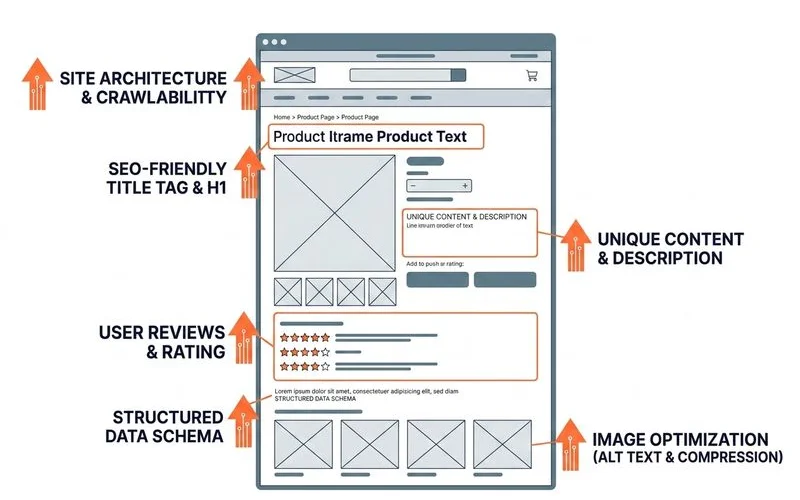
We often see service-business playbooks fail completely here because they miss what makes a store rank. A local plumber needs ten good pages, but a retailer needs thousands. We might target a specific product page for “buy industrial pump 2HP Malaysia” or a category page for “kids waterproof shoes”.
The goal is to capture a slice of the 25 million active online shoppers currently browsing in Malaysia. We know this requires a unique E-commerce SEO definition that prioritizes revenue over simple traffic.
What makes e-commerce SEO different
E-commerce SEO differs entirely because of massive page scale, dynamic inventory, and unique technical hurdles. We deal with specific architecture issues that simply do not exist on standard service-business websites. Those differences dictate our entire daily workflow.
We have identified five core elements that separate a store from a regular site:
- Product pages at scale: A typical store manages thousands of pages, and each individual URL needs a unique title, description, and image alt-text.
- Category architecture: The way you logically group products dictates how click-depth from your homepage affects organic ranking power.
- Faceted navigation indexation: Dynamic filters can generate millions of URL variations that cause massive duplicate-content issues if left unchecked.
- Schema data: Structured markup like Product and Offer schema directly drives rich-result eligibility in the search engine results pages.
- Image SEO at scale: Visual search brings in heavy traffic for retail products, requiring strictly optimized filenames and lazy-loading protocols.
Mastering these online store SEO basics prevents catastrophic technical errors. We regularly audit Malaysian sites where simple category mistakes bleed organic traffic. A single misconfigured category tree can hide your best products from Google completely. We always recommend building a flat architecture so search engines can crawl every item easily.
Faceted navigation: the invisible problem
Faceted navigation acts as the filtering and sorting system on category pages, allowing users to narrow down choices. We see this feature turn into a duplicate-content disaster when Google indexes every possible filter combination.
A 100-product category with five filters can quickly balloon into hundreds of thousands of thin URL variations. We call this an invisible problem because it quietly dilutes your category page authority.
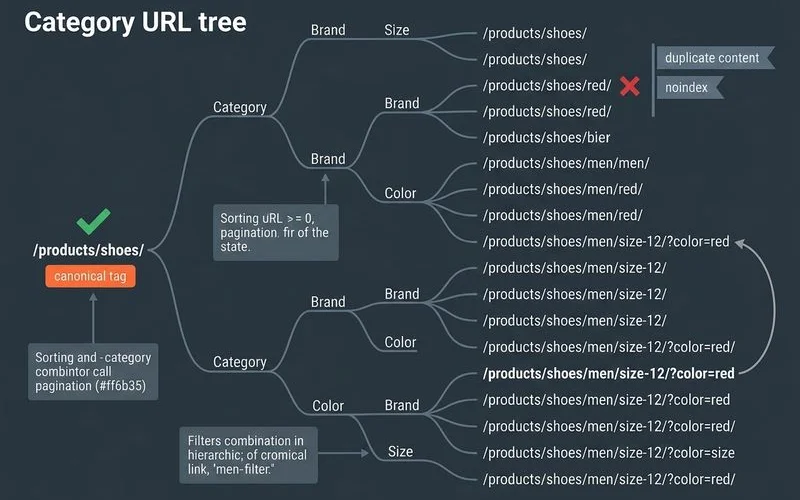
If Google indexes none of those filters, you miss valuable long-tail opportunities like “red shoes size 8”. We fix this by deploying a strict rule-based indexation strategy.
The smartest move is to index high-value combinations for your specific niche. We usually keep color and size open for fashion stores, while restricting the rest.
All other long-tail variations get a noindex tag or canonicalize back to the main category. We find that most store platforms get this wrong out of the box.
Schema markup is non-negotiable
Schema markup serves as a standardized code that helps search engines understand your product details. We consider Product, Review, and Offer schema non-negotiable because they enable high-converting rich results.
These visual enhancements include star ratings, price ranges in RM, and availability badges right in the search listings. We tracked recent 2026 data showing that pages with rich results experience 20 to 40 percent higher click-through rates.
Complete schema also feeds directly into Google Merchant Listings for broader visibility. We know that following these technical standards is crucial for standing out.
“Products with complete structured data are 4.2 times more likely to appear in Google Shopping results, making schema essential for retail visibility.”
Most popular store platforms like Shopify or WooCommerce ship with basic schema enabled by default. We frequently find major gaps in these defaults, such as missing AggregateRating or missing GTIN identifiers.
Closing those gaps remains one of the highest-leverage fixes a store owner can make. We prioritize adding explicit brand names and condition tags to dominate local competitor listings.
How E-commerce SEO compounds with other channels
Organic search delivers the highest return when integrated with Google Shopping, email marketing, and content strategies. We see tremendous growth when paid ads and organic rankings share data and feed off each other. Standalone organic campaigns grow much slower if they operate in a vacuum. We always pair organic efforts with email marketing to amplify the return on ad spend through smart retargeting.
Average cost-per-click rates in Malaysia for Google Shopping hover between RM 0.25 and RM 1.20 in 2026. We use those relatively affordable clicks to discover high-converting long-tail keywords. Once the paid data identifies a winning term, the organic strategy takes over to secure free traffic permanently. We find this dual-channel approach builds a protective moat around your most profitable products.
This synergy becomes clear when you compare the strengths of both channels side-by-side. We use a simple framework to balance short-term sales with long-term asset building.
| Channel Strategy | Speed to Market | Cost Structure | Best Use Case |
|---|---|---|---|
| Google Shopping Ads | Immediate | RM 0.25 - RM 1.20 CPC | Testing new products and capturing instant demand |
| Organic Product SEO | 3 to 6 Months | High initial effort, zero CPC | Building long-term margins and stable daily traffic |
If you are weighing these two options specifically, the E-commerce SEO vs Google Shopping comparison lays out exactly when each tactic wins. We highly recommend reading that breakdown before allocating your monthly marketing budget.
Sometimes your product pages still fall flat despite ongoing optimization work. We suggest reviewing the common reasons your product pages do not rank diagnostic to surface the seven most frequent causes.
Understanding what is E-commerce SEO gives your business a lasting competitive advantage. We encourage you to start by auditing your current product pages and category structures today. Stop letting third-party platforms eat your margins, and begin building an organic asset that pays dividends for years to come.
FAQ
How is E-commerce SEO different from general SEO?
E-commerce SEO has more technical complexity (faceted navigation, product schema, image SEO at scale, indexation rules) and inventory churn (products come and go, URLs change, stock-outs need handling). General SEO playbooks miss most of this and produce mediocre results on stores.
Does Google penalise duplicate manufacturer descriptions?
Not directly. Google does not issue manual penalties for duplicate manufacturer copy across multiple stores. But identical content competes with itself across the web, so unique product copy materially outperforms shared manufacturer text in rankings and conversion. For top-revenue SKUs, rewriting copy is non-negotiable.
Do small stores under 50 SKUs need E-commerce SEO?
It depends on the category. If you sell branded products people search for by exact name, basic E-commerce SEO foundations (titles, schema, image SEO) matter. If you have 10 SKUs selling commodity items competing on price, paid (Google Shopping) is usually a faster channel than SEO.
Related guides
Is E-commerce SEO Right for My Online Store?
Self-audit for online store owners, when E-commerce SEO compounds, when paid is enough, MRR thresholds, and dropship vs branded considerations.
Cost of E-commerce SEO Services in Malaysia (2026)
E-commerce SEO pricing for Malaysian stores by store size, platform-specific labour, content velocity, and migration costs. ROI benchmarks included.
What to Expect From Your First 6 Months of E-commerce SEO
Month-by-month milestones for your first 6 months of E-commerce SEO, audit, technical fixes, optimisation, content compounding, KPIs to track.
E-commerce SEO vs Google Shopping Ads
Honest comparison: E-commerce SEO vs Google Shopping Ads. CAC over time, when each dominates, ROAS expectations, and the hybrid stack approach.
Ready to talk about E-commerce SEO Services?
Our e-commerce seo services retainers are senior-led and tied to revenue. Free discovery audit, no obligation.